Inclusive Pathways in South Africa’s Just Transition: Women, Youth, and Mine Workers
This discussion explores South Africa’s just transition, the shift towards a low-carbon economy while ensuring that no one is left behind, through the lens of those most at risk of being marginalized: women, youth, and mine workers. The conversation examines the intersection of climate justice, social protection, and economic inclusion, and highlights the real-world impacts of the transition on livelihoods, care economies, and communities historically dependent on coal.
The speakers, Ms Thandile Zonke, Ms Boitumelo Molete and Ms Lebogang Mulaisi, explain that the just transition has many definitions depending on perspective, but at its core it is about social equity, centering workers and communities as active participants, and addressing South Africa’s unemployment, poverty, and inequality alongside its environmental goals. The concept originated in workers’ movements, particularly trade unions, and in South Africa it is deliberately broadened to include women and youth, who face particular vulnerabilities. Workers, the speakers stress, are never separate from communities, so policy must address both at once.
The discussion draws attention to the compounded burdens women carry: economic marginalization, unpaid care work, health challenges, and gender-based violence, all of which are worsened by climate events such as the Limpopo floods. In coal-dependent regions like Mpumalanga, mine workers and their families fear job losses and community decline, which is why social dialogue led by strong unions such as the National Union of Mine Workers (NUM) is seen as critical. Barriers such as a lack of childcare and early childhood development (ECD) centers, wage disparities, unsafe workplaces, and fragmented funding limit inclusive participation.
The conversation closes by presenting the just transition as a chance to negotiate a new social compact rather than a purely technical or industrial shift. Success depends on social protection, skills development, economic diversification, gender-responsive policies, and close coordination among government, labor unions, civil society, and communities, with the voices of impacted people at the center.
This discussion presents the just transition not merely as a technical or industrial shift but as a profound social transformation, one that calls for resolve, inclusivity, and a collective vision of dignity and opportunity for all, built by listening to and empowering the communities most affected.
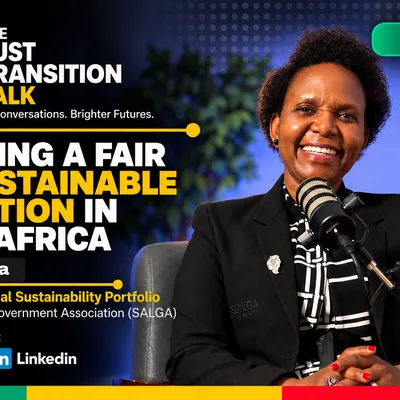
This discussion explores the complexities of achieving a fair and sustainable just transition in South Africa, emphasizing the critical importance of fairness for mine workers, local communities, women, and the broader society. Drawing on p …
This podcast conversation explores the intersection of youth employment and the just energy transition (JET) in South Africa, focusing on the rise of green jobs and the green economy. It highlights the opportunities, challenges, and enablin …
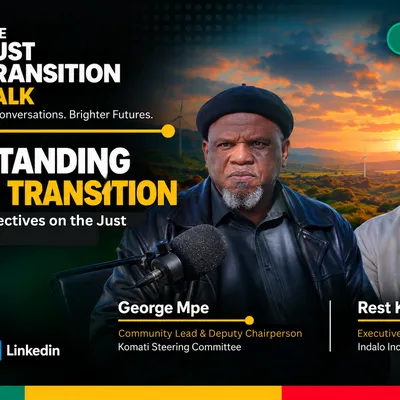
On this episode of the Just Transition Talk podcast, we explore the complex yet crucial concept of the just transition through the lived experiences and insights of community members and practitioners in South Africa’s coal-dependent region …
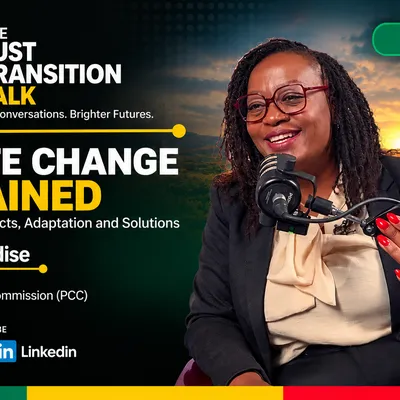
This podcast episode initiates a series aimed at unpacking key concepts surrounding climate change and the just transition, especially within the South African and Mpumalanga provincial context. The host interviews Ms Dorah Modise, Executiv …
In this episode of the Tips Podcast series, host Thobani K speaks with Bhekani Hadebe, Acting Senior Manager: HV Substations at eThekwini Municipality, about the practical challenges and opportunities involved in preparing municipal electri …
In this episode of the TIPS Podcast series, host Nothembi Mahlangu speaks with Omogolo Tlape, Deputy Director for Macroeconomic Analysis at the North West Provincial Treasury, about the role of economic planning and evidence-based policymak …
In this episode of the TIPS Podcast series, host Thobani K speaks with Dr Bonginkosi Robert Dlamini, Chief Director for Environmental Management in the KwaZulu-Natal Department of Economic Development, Tourism and Environmental Affairs (EDT …
In this episode of the TIPS Podcast series, host Thobani K speaks with Sindi Shozi, Chief Engineer for Advanced Metering Infrastructure at the eThekwini Municipality, about the practical role that technology, infrastructure planning, and en …
The tool is designed to be used by everyone – from a large multi-national company to SMMEs to informal community groupings and is applicable across sectors and various lifecycles of a project.
We use necessary cookies to make this website work. With your permission, we also use analytics cookies to understand how people use the JustSA website and improve it.
Customise Consent Preferences
This site uses cookies to help you navigate efficiently and perform certain functions. You will find detailed information about all cookies under each consent category below.
The cookies categorised as Necessary are stored on your browser as they are essential for enabling the basic functionalities of the site. We also use analytics cookies to understand how you use this website; you can switch these off below at any time. Marketing cookies are only stored in your browser with your prior consent.
Required for core website functions, security and remembering your cookie choices. These cookies cannot be switched off.
Cookie
Duration
Description
CRAFT_CSRF_TOKEN
Session
Protects forms and consent logging against cross-site request forgery.
PHPSESSID
Session
Preserves session state when a Craft session is required.
flow_cookie_consent_justsa
1 year
Remembers your cookie consent preferences in local storage.
Matomo analytics helps us understand which pages are used and how visitors move through the website. Matomo loads only if you accept analytics cookies.
Cookie
Duration
Description
_pk_id.*
13 months
Matomo uses this to recognise a returning browser for analytics.
_pk_ses.*
30 minutes
Matomo uses this to group page views into one visit.
JustSA does not currently use marketing or advertising cookies.