Policy Brief: The potential of tourism for economic diversification of the Mpumalanga Coalfield
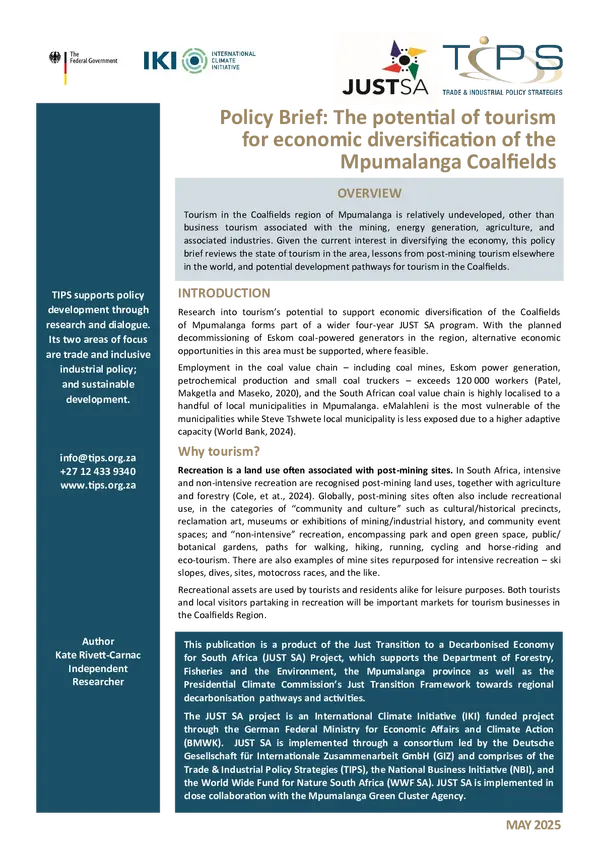
Overview: This policy brief is based on a tourism study covering the coalfields region of Mpumalanga that forms part of TIPS`s research on economic diversification. The study reviews the state of tourism in the area, lessons from post-mining tourism elsewhere in the world, and potential development pathways for tourism in the Coalfields.
The research forms part of the Just Transition work examining practical pathways to diversify the coal-dependent economy of Mpumalanga as coal mining and coal-fired power generation decline. The region is highly dependent on the coal value chain, with over 120,000 workers employed in coal mining, power generation, petrochemicals and related activities, concentrated in a few municipalities such as eMalahleni.
Because the phase-out of coal power stations will significantly affect local employment and economic activity, the study explores tourism and recreation as potential complementary economic sectors that could contribute to regional diversification and new job creation. However, the research stresses that tourism alone cannot replace coal-sector employment, but it can support new small business opportunities, local enterprise development and place-based regeneration, particularly if linked to heritage, environmental restoration and recreational land uses on rehabilitated mining sites.
The research concludes that tourism can play a supporting role in the economic diversification of Mpumalanga’s coalfields, particularly through post-mining land rehabilitation, SME development, and destination planning, but it must be integrated into a broader multi-sector Just Transition strategy.
Key Findings:
The Mpumalanga coalfields currently have limited tourism activity, largely focused on business travel linked to mining and energy industries.
The coal phase-out represents a trigger event that could reshape the regional economy and create opportunities for new tourism-based economic activities.
Tourism development in the region requires strong public-sector support and coordinated planning, as current tourism actors have limited resources and influence.
Post-mining landscapes can be repurposed for recreation, cultural heritage attractions, green spaces and eco-tourism, which can benefit both residents and visitors.
Diversification must be multi-sectoral, combining tourism with other sectors such as agriculture, renewable energy and SMME development to ensure sustainable economic transformation.
Recommendations:
Globally, many former mining regions have diversified through post-industrial tourism, including cultural heritage tourism, recreation, ecological restoration and community-based tourism initiatives. These models can inform development pathways for Mpumalanga.
Develop Tourism as Part of a Broader Diversification Strategy: Tourism should complement—not replace—other sectors such as agriculture, renewable energy, and manufacturing in regional economic diversification.
Repurpose Post-Mining Land for Tourism and Recreation: Rehabilitated mines could be transformed into: Cultural and mining heritage museums; Recreational parks and outdoor activity area: Eco-tourism and nature-based tourism sites; and or Community event spaces and cultural precincts.
Strengthen Local Tourism Institutions and Actors: Public support is needed to increase the capacity and agency of tourism stakeholders, including local businesses, municipalities and community organisations.
Promote Local SME and Community-Based Tourism: Support the development of small tourism enterprises, including accommodation, guiding services, cultural experiences and recreational activities.
Improve Infrastructure and Destination Development: To consider investment in one or more of these areas - Local transport connectivity, Tourism infrastructure and amenities, and Destination branding and marketing strategies.
Integrate Tourism with Just Transition Policies: Tourism initiatives should be aligned with Just Transition programmes, ensuring: worker reskilling opportunities, community participation and inclusive local economic development.
Use the Coal Transition as a Catalyst for Regional Regeneration: The phase-out of coal should be leveraged as an opportunity to reimagine the coalfields economy, combining environmental restoration with new economic activities and community development.
Source:
Download the Policy Brief
Download the Scoping Study
Related source: Access the Development Dialogue (presentation slides and YouTube video): Date 5 March 2026, see link: https://www.tips.org.za/events/development-dialogue-seminar/item/5058-learning-event
More Green economy interventions research